
October 28, 2026
Jason Swensen
Unique partnership between USA Bobsled/Skeleton and several Utah high-tech companies announced at 47G’s Zero Gravity Summit
The German bobsled team that won the gold medal at this year’s Winter Olympics in the men’s four-man bobsled event finished with a total time of 3 minutes and 37.57 seconds.
Another German squad finished just over a second behind their countrymen — and left Italy without a medal.
In 2026, the difference between ascending the medal podium and basking in Olympic glory or being relegated to “did not medal” status was roughly equal to the time it takes to type four or five keystrokes on a laptop.

Germany's gold medalists Johannes Lochner, left, and Germany's silver medalist Francesco Friedrich, right, celebrate at the finish after the four man bobsled competition at the 2026 Winter Olympics, in Cortina d'Ampezzo, Italy, Sunday, Feb. 22, 2026. | Alessandra Tarantino, Associated Press
The bottom line in bobsledding and other sliding sports: Advantages are measured in milliseconds.
Now a newly announced partnership between USA Bobsled/Skeleton and a collection of Utah-based advanced composite and hard-tech manufacturers may be the X-factor in securing medals for American sliding athletes at Utah’s 2034 Winter Games and beyond.
The unique collaboration was announced Wednesday at 47G’s annual Zero Gravity Summit being held during Salt Lake City’s ongoing Hard Tech Week. 47G is a Utah network of over 200 organizations participating in the state’s emerging aerospace, defense and hard tech industries.
The companies working with USA Bobsled/Skeleton — Albany Engineered Composites, Hexcel, and Nammo Composite Solutions — are typically associated with Utah’s hard-tech ecosystem that focuses on industries such as aerospace, advanced materials, manufacturing and defense.
But such partnerships in support of Team USA are “a great reminder” that innovation often comes from seemingly unlikely places, said Americas & Global Fibers President Lyndon Smith in a 47G release.
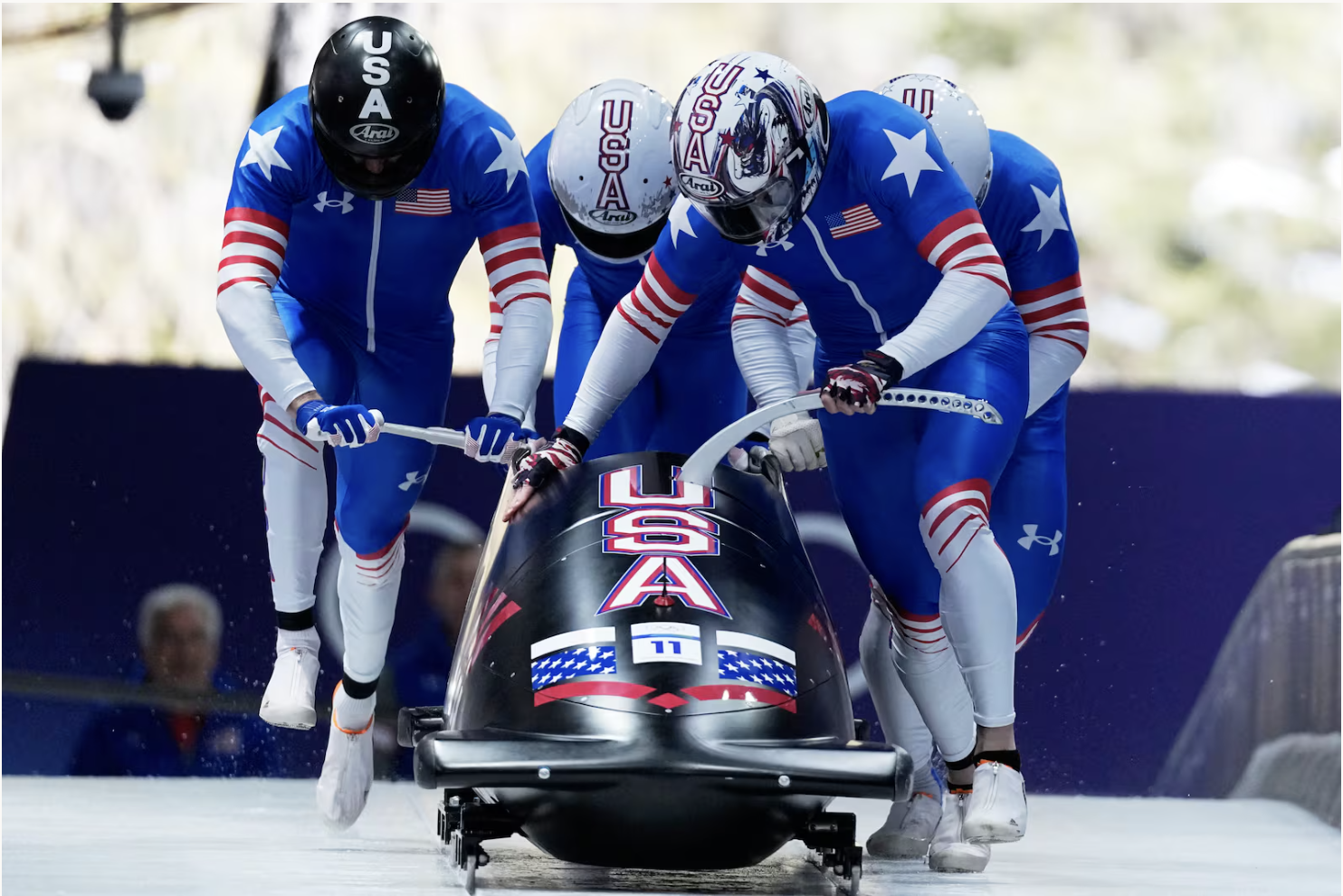
United States' Kristopher Horn, front, Caleb Furnell, Hunter Powell and Carsten Vissering start for a four man bobsled run at the 2026 Winter Olympics, in Cortina d'Ampezzo, Italy, Saturday, Feb. 21, 2026. | Alessandra Tarantino, Associated Press
“The same advanced materials and technical expertise that support aerospace and defense can open new possibilities in elite sport,” said Smith. “We’re excited to work alongside USA Bobsled/Skeleton and our industry partners to see what we can accomplish together.”
Each of the companies partnering with USABS lend expertise that’s vital to building the world’s speediest bobsled.
Albany will work with USABS to manufacture next-generation composite bobsleds for American athletes. Hexcel is contributing advanced composite materials expertise. And Nammo
Composite Solutions will manufacture carbon-fiber cowlings for the team’s two-man bobsleds.
The “cowling” is the hull, or main shell, of a bobsled. Elite sliding programs are continuously searching for new tech to make their cowlings more aerodynamic as they race down the ice track.
Building a quicker sled: Drawing upon lessons from defense/aerospace

Aaron Starks, CEO and president of 47G, speaks during a meeting between various defense and aerospace industry leaders and the editorial board of the Deseret News at the Triad Center in Salt Lake City on Monday, Oct. 26, 2026. | Lukas Katilius, Deseret News
Representatives from USA Bobsled/Skeleton and their new Utah industry partners met Monday with the Deseret News Editorial Board to discuss their collaborative vision.
47G CEO/President Aaron Starks recalled visiting with reps from the US Olympic & Paralympic Committee a couple of years ago and quickly recognized the possibility of connecting several companies from the 47G family with the USABS to help build the next generation of bobsleds.
“Even outside of bobsled, there’s a lot of opportunities for the aerospace, defense and hard tech industries here to step up and help our athletes be more competitive,” said Starks. “We’ve already got the technology to do it. So this is really an interesting confluence of community, industry, and professional sports coming together to elevate the state.”
USA Bobsled head coach Chris Fogt knows well the challenges of making a sled a split-second faster.
A Utahn and a silver medalist in the 2014 Sochi Games, Fogt coached his team to three medals, including a gold, in the recent Milan Cortina Games. But he’s already looking ahead to future Olympics, including Utah 2034.
The sledding teams with the best tech will likely be those visiting the medal podiums.

Chris Fogt, coach of the USA Bobsled Team, speaks during a meeting between various defense and aerospace industry leaders and the editorial board of the Deseret News at the Triad Center in Salt Lake City on Monday, Oct. 26, 2026. | Lukas Katilius, Deseret News
“I’m very passionate about what these guys do,” said Fogt, pointing to his new industry partners. “I’m very appreciative of all it gives us. Not only do we want to win because we’re athletes, but we want to win for our country. And to put the ‘USA’ on your chest, and to be from this state and have this stuff made here. … You just can’t change the way that makes our athletes feel.”
An active-duty Army officer, Fogt does not come from a hard tech industry background. And the Utah companies he now calls partners have no competitive bobsledding experiences. But together, they’ve found a common language that they hope will result in the world’s speediest sleds.
Albany Vice President Jeff Daniel noted that his team will not be actually assembling sleds. Instead, Albany is fabricating components for the four-man bobsled.
“We’ve got some prototypes that have already been manufactured, along with our tools,” said Daniel. “So we’ve got initial tools in and we’ve already manufactured some prototypes for (the bobsledders). We’re in the process now of getting these parts to where the athletes can do testing later this year.”
Hexcel, explained Vice President of Defense & Space Programs Jason Burns, will be providing the raw materials needed to make bobsled parts. The products to be used in the bobsled equipment meet defense- and aero-grade standards.
“We’re not giving them the bicycle-type material,” said Burns. “This is the same stuff that’s on the F-35 fighter jet. The same stuff that’s on B-2s, Apaches, B-21, and CH-53K helicopters.”
And the same fabricating process Nammo uses for missiles and aircraft will be utilized making sled parts, added Nate Lodder, the company’s president and general manager.
“The same technicians that know how to build aircraft and missiles and rockets are applying those same techniques to produce parts for the sled,” he said.
The improved bobsled building, said Fogt, is already underway in hopes of having systems optimized in time for the 2030 Winter Games in the French Alps.
Can Utah’s collaborative culture lead to Olympic gold?
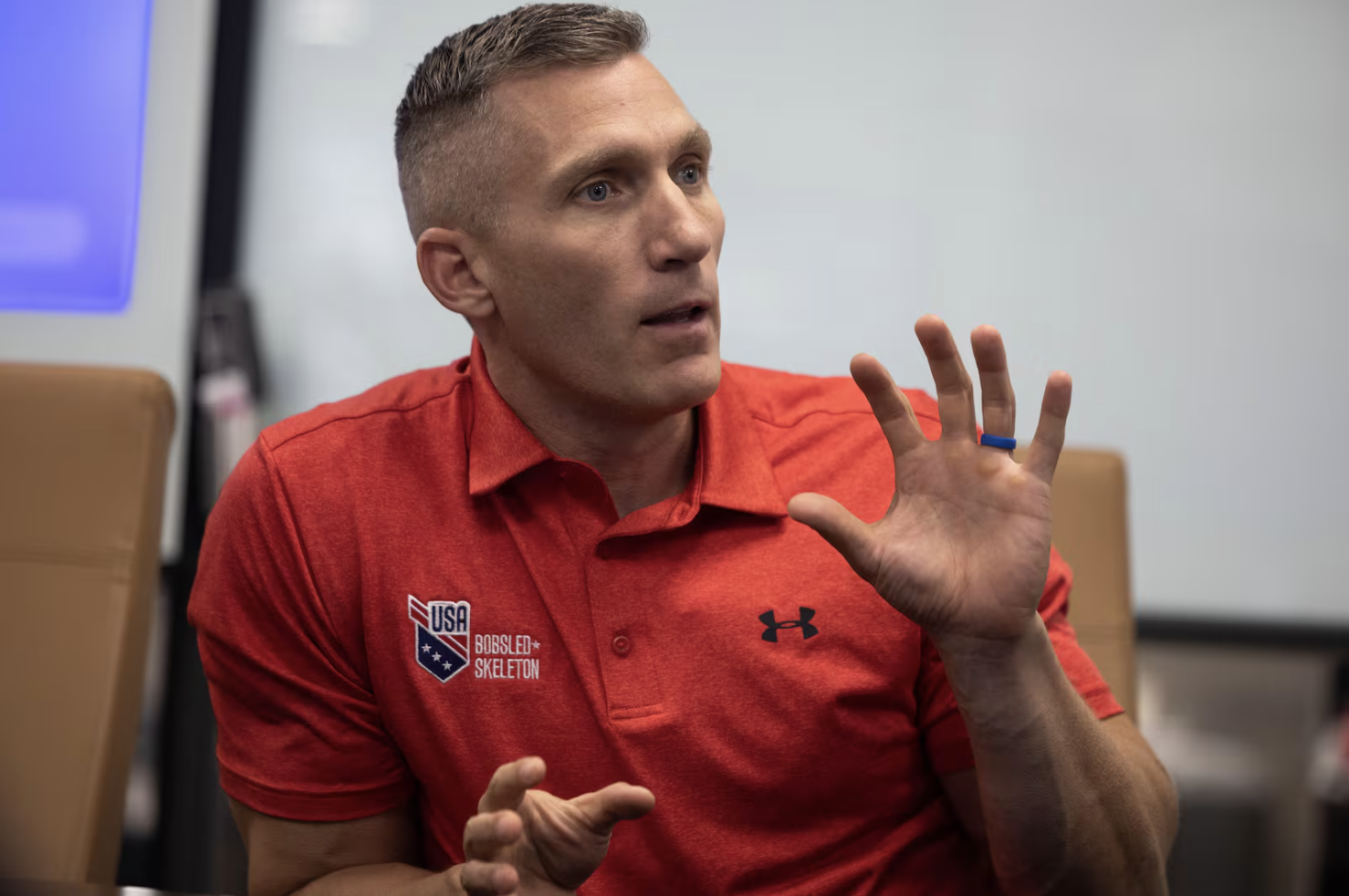
Chris Fogt, coach of the USA Bobsled Team, speaks during a meeting between various defense and aerospace industry leaders and the editorial board of the Deseret News at the Triad Center in Salt Lake City on Monday, Oct. 26, 2026. | Lukas Katilius, Deseret News
The partnership between USABS and the 47G companies will allow Team USA to keep competitive pace with the Germans, the Swiss, the Latvians and the other heavyweight bobsledding nations.
“To be successful, you have to have three things,” explained Fogt. “You have to have good pilots, good technology and good brakemen. So our job is to get the brakemen and the pilots. And we have some very good coaches and some very good recruits across this country recruit from track & field and football.”
But even the best athletes, the coach added, can’t succeed without the best tech.
“Our drone technology and all the things that we do in the Army, you apply that same thing to bobsled — to our technology for our sport — and it gives us that edge.
“If we can get hundredths (of a second faster), we will win more medals than we’ve ever won.”
The collaborative spirit that’s allowing Utah to take the national lead in the private aerospace and defense industry, said Starks, can seamlessly translate to athletics and high-tech sports such as bobsledding.
“Utah is just uniquely positioned for all of it. … We have a state that’s willing to invest. We have industry that’s willing to collaborate. And we’re still a very young population that’s attracting talented workers,” he said.
https://www.deseret.com/utah/2026/10/28/47g-bobsled-olympics-utah-industry/
